

Views: 0 Author: Air Filter Materials Comparison Publish Time: 2025-12-19 Origin: OEM Air Filter Standards


Within a scheduled maintenance regimen, timely air filter replacement is paramount. Functioning as the decisive checkpoint for intake air quality, its condition critically governs engine operational efficiency, emission output, and service interval integrity.
The primary function of an engine air filter is to clean the incoming air before it enters the engine. During vehicle operation, ambient air carries a significant volume of contaminants such as dust, pollen, and particulate matter. Without an effective air filtration system, these abrasive particles would enter the combustion chambers directly, leading to accelerated wear of internal engine components.
For instance, the wear of piston rings and cylinder walls would compromise engine sealing, resulting in reduced power output and increased fuel consumption. Studies indicate that an engine operating without a functional air filter can experience wear rates 3 to 5 times faster than under normal, filtered conditions.

Effective air filtration ensures optimal engine combustion efficiency. When clean air enters the engine, it mixes more thoroughly with fuel, promoting more complete combustion. This not only enhances power output but also reduces exhaust emissions. Conversely, a clogged air filter restricts airflow into the engine, leading to incomplete fuel combustion. This results in the production of harmful pollutants such as carbon monoxide and hydrocarbons, which contribute to environmental pollution and fail to meet modern emission standards.
Regular air filter replacement also extends engine service life. As the heart of the vehicle, the engine represents a significant maintenance cost. By replacing the filter periodically, impurities are prevented from causing internal damage, thereby reducing the likelihood of engine failures and lowering long-term repair expenses. In general, adhering to the vehicle manufacturer’s recommended replacement schedule can extend engine life by approximately 10–20%.
To better illustrate the importance of a functional air filter, the following table contrasts vehicle performance under normal versus clogged filter conditions:
Performance Aspect Normal Air Filter Clogged Air Filter
Power Output | Strong, responsive acceleration | Reduced, sluggish acceleration |
Fuel Consumption | Within normal range | Increased |
Exhaust Emissions | Compliant with environmental standards | Exceed regulatory limits |
Engine Wear | Gradual | Accelerated |
In summary, regular air filter replacement is essential for maintaining vehicle performance, meeting environmental requirements, and preserving engine longevity. Vehicle owners should follow the maintenance schedule outlined in the owner’s manual, performing regular inspections and timely replacements to ensure their vehicle operates reliably and efficiently.
The automotive air filter is a critical component of the engine intake system. Its primary function is to remove dust and other airborne contaminants from the incoming air, thereby protecting the engine and enhancing combustion efficiency. Common filter media include paper, cotton gauze, foam, and synthetic fibers, each offering distinct characteristics in terms of filtration efficiency, durability, and airflow permeability.
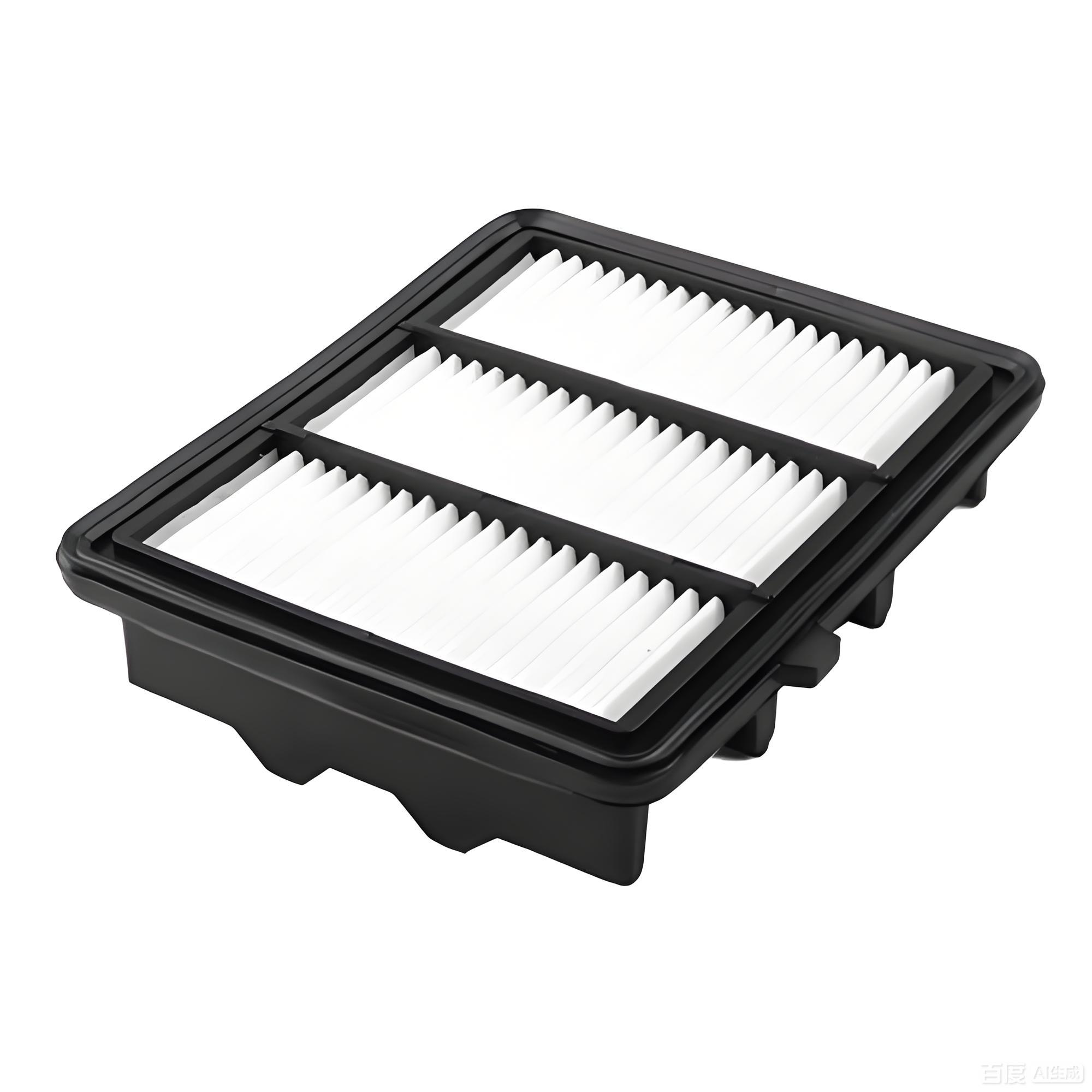
Paper Filters: The most traditional and cost‑effective type. They provide good filtration and effectively trap most dust particles. However, they are generally disposable and may become clogged over time, which can restrict airflow and reduce performance.
Oiled Cotton Gauze Filters: Often used in high‑performance or modified vehicles. These filters are treated with oil to achieve high filtration precision and are reusable after cleaning. They offer excellent durability but are more expensive. Proper installation is essential to ensure a tight seal and prevent unfiltered air from bypassing the filter.
Foam Filters: Lightweight with good airflow characteristics. They are commonly found in older vehicles or specific applications. Their filtration efficiency is generally lower than other types, and they tend to retain oil and dirt, requiring regular maintenance.
Synthetic Fiber Filters: Combine the advantages of multiple materials. Some advanced synthetic filters incorporate an electrostatic layer to capture fine particles efficiently while maintaining a balance between durability and airflow. They are a popular choice for modern vehicles.
When selecting an air filter, practical considerations such as driving conditions, maintenance intervals, and budget should be taken into account. For example, in dusty urban environments, a filter with high filtration efficiency such as oiled cotton or advanced synthetic media may be preferred. For long‑distance highway driving where sustained engine performance is key, a filter with optimized airflow permeability is often the better choice.
In-Depth Analysis of OEM Standards
For an OEM manufacturer, meeting standards transcends simple dimensional fit. It represents a comprehensive commitment to a rigorous protocol of performance validation, material qualification, and durability testing, such as the globally recognized ISO 5011 for intake air filters.
OEM validation is a gauntlet of engineered challenges designed to simulate a lifetime of extreme operating conditions. Key tests that define true OEM-grade quality include:
Burst Pressure Test: Ensures the filter media and housing can withstand sudden pressure spikes without failure.
Oil Mist Resistance Test: Verifies that the filter media maintains its structural integrity and filtration efficiency when exposed to oil-laden air.
Pulse Fatigue Test: Subjects the filter to thousands of rapid pressure pulses to simulate real-world engine load cycles, testing the durability of the media and seals.
High-Temperature Deformation Test: Confirms the filter assembly retains its shape and sealing properties under sustained high heat.
At WHY Group Inc., our manufacturing philosophy is built around satisfying these "invisible" standards. Our quality is engineered in, not inspected in. This is achieved through:
Material Science: We source and qualify advanced filtration media and polymers specifically formulated to pass OEM chemical and thermal resistance specifications.
Precision Manufacturing: Our automated production lines and controlled bonding processes guarantee consistent seal integrity and dimensional accuracy for every single unit.
Integrated Quality Gates: Our in-house testing labs replicate core OEM validation protocols as part of our production control, ensuring every batch delivers predictable, certified performance.
For us, OEM standards are not just a checklist; they are the foundational blueprint for our process control. This systemic approach is what transforms a component from merely "fitting" to being a fully guaranteed, performance-matched original-equivalent part. It is the assurance we provide to our partners that our filters will perform reliably and protect the engine for the designed service life, under all specified conditions.
The core premise is unequivocal: a premium air filter is not a mere consumable, but a fundamental preventive investment in the health of the engine. It safeguards performance, ensures emissions compliance, and protects against premature, costly wear. The true cost is measured not in the price of the part, but in the total cost of ownership it secures.
For fleet managers, distributors, and engineering partners, verification is key. We invite you to move beyond claims and validate the OEM-grade engineering of our products firsthand.
Take the next step in securing your engine protection:
Request our Detailed Product Specifications for precise technical data.
Download our Technical Whitepaper on filtration efficiency and durability testing.
Order Evaluation Samples to perform your own audits and fit-checks.
Contact our technical team today to request these resources. Let us demonstrate how our commitment to invisible standards delivers visibly superior protection and value.


 Company Name: WHY Group Inc.
 Brand: WYA Tech
 Mob / WhatsApp: +1 (514) 585-7511
 E-mail: info@wyatech.com / villaw@gmail.com
 Add: Qinghe County Industrial Zone, Xingtai City, Hebei Province, China


